
The Browser Bookmark Problem - Rons WebLynx
Most people think they have a search problem.
In reality, they usually have an organization problem.
Finding information online has never been easier. Search engines, AI assistants, social media, recommendations, and online communities constantly expose us to useful websites, articles, tools, and resources.
The challenge is not discovering information; the challenge is BEING ABLE to find it again six months later.
This is one of the reasons dedicated bookmark management tools have become popular among researchers, professionals, and anyone who regularly collects information from the web. To understand why, it helps to look at the limitations of traditional browser bookmarks and the challenges that emerge as collections grow.
Browser Bookmarks Seem Simple
Every major web browser includes bookmarks or favorites and for small collections, they do work well. You find a useful website, save it, and move on.
The trouble begins when the collection grows: a few dozen bookmarks can be managed without much effort, however, a few hundred bookmarks become less comfortable. A few thousand bookmarks can become nearly impossible to navigate efficiently.
Many users eventually discover that they spend almost as much time looking for a saved website as they would finding it again through a search engine.
The Folder Problem
The traditional solution is folders.
For example:
Research
    Canada
        Government
            History

Technology
    Software
        Applications

Travel
    Europe
Folders provide structure, but they also introduce limitations. A website can only exist in ONE location.
Consider a website discussing Canada's electric vehicle industry.
Should it be stored under:
- Canada
- Transportation
- Industry Research
- Government Policy
The answer is often ALL four.
Folders force a single decision where multiple classifications would be more useful.
Information Loses Context
Another common problem is that bookmarks rarely explain why they were saved.
Imagine opening a bookmark collection from three years ago.
You may recognize the website name, but questions quickly arise:
- Why did I save this?
- Was this source trustworthy?
- Which information was important?
- Is this still relevant?
Without notes, ratings, or descriptions, a bookmark often becomes little more than a URL.
The information surrounding the link is frequently more valuable than the link itself.
Browser Bookmarks Blur Everything Together
Most people use the same browser for many different activities:
- Work
- Personal interests
- Shopping
- Travel planning
- Research
- Hobbies
Over time these bookmarks become mixed together.
A research source can end up beside a recipe, an online store, and a video channel.
The result is a collection that grows continuously but becomes increasingly difficult to use.
Research Requires More Than Saving Links
Researchers have long understood that collecting information and organizing information are different tasks.
Whether researching family history, software products, academic subjects, legal matters, genealogy, or business opportunities, successful researchers do more than save links.
They create systems.
Those systems typically include:
- Categories
- Tags
- Notes
- Ratings
- Search capabilities
- Project organization
The goal is not simply to store information: the goal is to make information useful in the future.
Folders and Tags Work Better Together
One of the most effective approaches combines folders and tags.
Folders provide structure.
Tags provide flexibility.
For example, a website may be stored inside a Research folder while also carrying tags such as:
- Canada
- Transportation
- Electric Vehicles
- Government Policy
This allows information to be found through several different paths rather than only one.
As collections grow, this flexibility becomes increasingly valuable.
Building a Personal Web Research Database
A useful way to think about bookmark collections is not as a list of websites but as a personal research database.
Each saved resource can contain:
- A title
- The website address
- Notes
- Tags
- Ratings
- Comments
Viewed this way, the purpose changes completely.
You are no longer collecting bookmarks: you are building a searchable archive of knowledge.
This approach helps preserve information that might otherwise be forgotten or lost.
Choosing the Right Tool
Many people eventually reach a point where browser bookmarks are no longer enough.
That does not mean browser bookmarks are bad. They simply were not designed to manage large research collections.
Dedicated bookmark management tools provide features specifically intended for organizing growing collections of information.
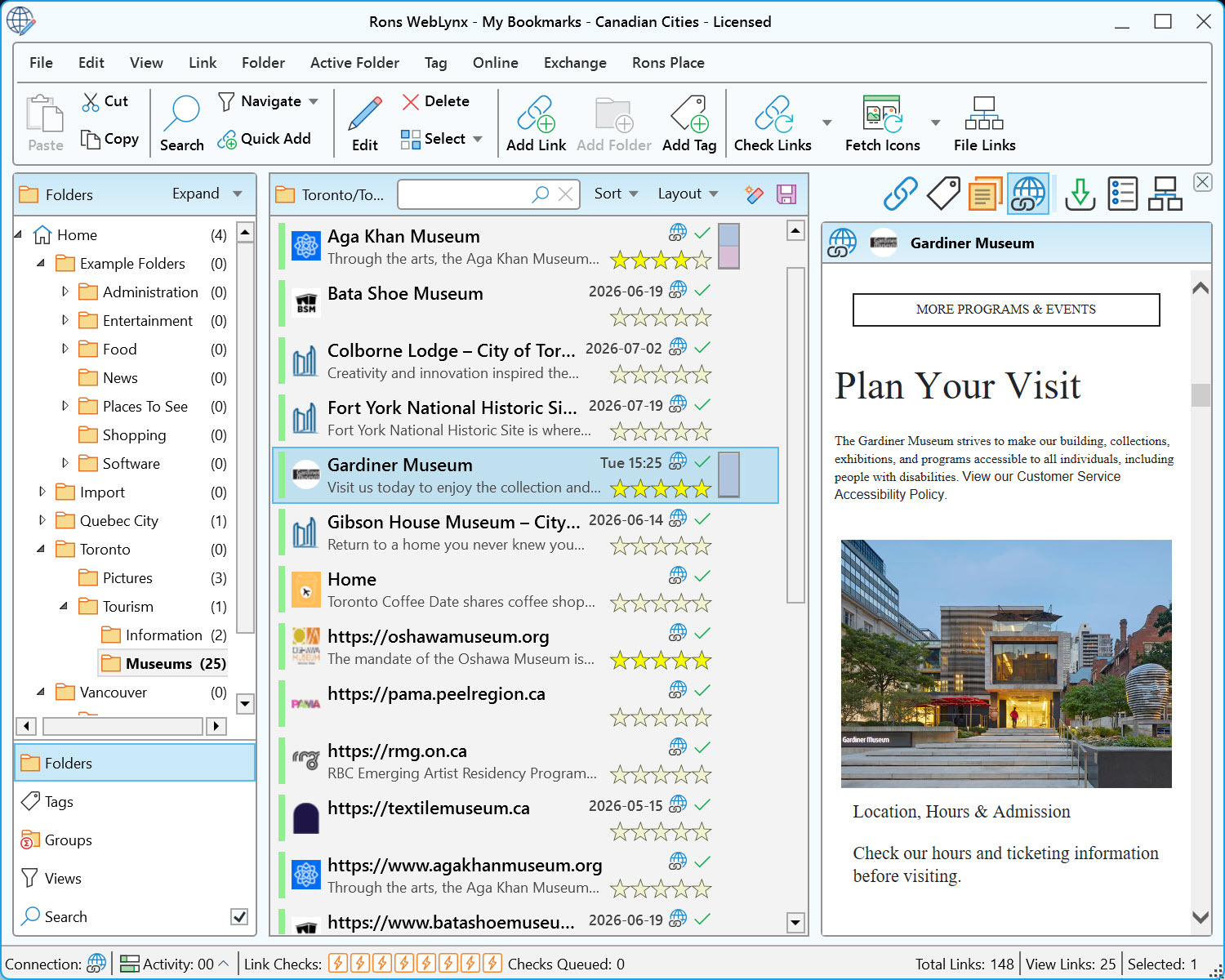
Among these, Rons WebLynx stands out because it approaches web links as information assets rather than simple bookmarks.
Folders, tags, notes, ratings, search tools, duplicate detection, broken-link management, and flexible import options make it particularly well suited to long-term research and knowledge organization.
More importantly, it remains focused on a simple goal: Helping users find their information again.
Conclusion
The internet makes it easy to discover information. The challenge is keeping that information organized in a way that remains useful months or years later.
A good organizational system transforms a collection of saved websites into a valuable personal resource.
For users who maintain large collections of websites, dedicated tools such as Rons WebLynx offer features including folders, tags, notes, ratings, searching, and link management designed specifically for handling growing research collections.
The internet provides an endless supply of information. The real advantage comes from building a system that allows you to find your own discoveries again when you need them most.
Rons WebLynx can be downloaded for free on the Download page on the Rons Place Software website.
Related Information
Rons WebLynx
Application
General


